• Features
  • Videos
  • Podcasts
  • Specials
  • Articles
  • Shorts
Donate
    • English
    • Français
    • Swahili
  • English
  • Español (Spanish)
  • Français (French)
  • Bahasa Indonesia (Indonesian)
  • Brasil (Portuguese)
  • India (English)
  • हिंदी (Hindi)
  • বাংলা (Bengali)
  • Swahili
  • Videos
  • Podcasts
  • Articles
  • Short News
  • Feature Stories
  • The Latest
  • Explore All
  • About
  • Team
  • Contact
  • Donate
  • Subscribe page
  • Submissions
  • Privacy Policy
  • Terms of Use
  • Advertising
  • Wild Madagascar
  • For Kids
  • Mongabay.org
  • Reforestation App
  • Planetary Health Check
  • Conservation Effectiveness
  • Mongabay Data Studio

Rare Southern African succulent listed as critically endangered amid mining threat

Victoria Schneider 5 Oct 2026
The brown clockfig, an extremely rare succulent growing in the hot, arid border region of Namibia and South Africa, was recently assessed as critically endangered by the IUCN, the global wildlife conservation authority. The western Gariep Valley is a vast landscape spanning the southern part of Tsau ǁKhaeb National Park in Namibia and the Richtersveld region of Northern Cape province in South Africa. It’s in this harsh environment, shaped by extreme heat and dryness, that the brown clockfig (Cheiridopsis brownii) grows on quartz ridges, shale, gravel, and sandy soils, and in cracks and fissures in desert mountains. The IUCN estimates the species, with thick leaves and daisy-like yellow flowers, has a total range of 424 square kilometers (164 square miles) in the valley, but occupies only around 60 km2 (23 mi2) of this area. Habitat loss due to overgrazing is among its major threats. Another is the demand for mineral resources such as diamonds, with mining permits being issued across the region. That’s placed more of the species’ already limited habitat under pressure in both South Africa and Namibia. “The vast desertification of the Aniesvlakte [plain in South Africa's Richtersveld region] as a direct result of severe overgrazing, as well as the mass desertification caused by sand moving from the coast due to unrehabilitated mines, are threatening to swallow most of the remaining population in South Africa,” Pieter van Wyk, a botanist with South African National Parks (SANParks), who carried out the most recent assessment, told Mongabay via email. Another threat comes from new green-energy developments — massive-scale green hydrogen projects — planned over vast sections of where this species occurs, van Wyk said. Additionally, a prolonged drought from 2012-202, combined with other factors, resulted in a decline in the species’ population of 50-90% since 1992. Climate change is expected to intensify these pressures, bringing higher temperatures and declining rainfall to the region. By 2052, the IUCN assessment projects that another 80-100% of the population could be lost. It adds that targeted conservation activities are not currently being conducted for the plant. Van Wyk said it’s crucial to protect all the brown clockfigs in the extremely dry, low-lying areas of the Gariep Desert adjacent to the Oranje River, since they support insects that in turn sustain the region’s highly arid- and heat-adapted spiders and reptiles. However, the species’ population has reached levels so concerning that the Richtersveld Desert Botanical Garden, founded and curated by van Wyk, has started collecting specimens for conservation. This includes seeds that van Wyk collected in 2021 from an area where populations were designated to be destroyed for diamond mines. Van Wyk said it “remains shocking” that a highly resilient species like the brown clockfig can easily grow in circumstances where no human can survive, yet “simply cannot survive the land use practices” wrought by humans. Banner image: A brown clockfig in South Africa’s Gariep Valley. Image © pietermier via iNaturalist (CC BY-NC 4.0).
A brown clockfig in South Africa’s Gariep Valley. Image © pietermier via iNaturalist (CC BY-NC 4.0).

Uganda and NGO to co-manage sector of national park home to tree-climbing lions

Ashoka Mukpo 2 Oct 2026
The Uganda Wildlife Authority (UWA) and the Wildlife Conservation Society (WCS) have signed a 10-year agreement to co-manage a portion of Queen Elizabeth National Park, famous for its tree-climbing lions. WCS will take over some day-to-day roles for the Ishasha Sector in the south of the park, including those covering biodiversity management, community engagement and the development of tourist enterprises, according to WCS Uganda country director Simon Nampindo. UWA will retain responsibility for law enforcement and wildlife protection in Ishasha, he added. The agreement follows a wider trend of “public-private” partnerships between African governments and conservation organizations to manage parks. “Across all pillars, WCS and UWA will work closely in the co-development and implementation of all activity workplans and budgets,” Nampindo told Mongabay by email. Queen Elizabeth’s Ishasha Sector covers around 500 square kilometers (193 square miles) of the park’s 1,978 km2 (764 mi2) area. Historically, Ishasha’s lions have been a magnet for tourists, but the animals are becoming rare. According to UWA’s figures, the overall lion population in Queen Elizabeth declined by more than 90% between the late 1970s and 2022, falling from 400 to 39 individuals. Nampindo said there are now fewer than five lions in Ishasha. Unless that population is supplemented — likely through translocation from elsewhere — it will not be able to recover naturally. Queen Elizabeth’s lions have faced several overlapping threats, including conflict between the predators and local herders, habitat loss and snares set by poachers in the park. Nampindo said these causes of lion decline need to be addressed before any translocations take place. Since 2018, lions have been killed by people living in and around the park in a series of incidents. In 2021, a poisoned carcass caused the death of at least six lions. In late 2025, another three lions died under similar circumstances. Mongabay’s reporting from Queen Elizabeth has found a tense relationship between some pastoralist communities and the UWA. Attacks on livestock by lions have fed long-standing grievances over strict grazing rules and contributed to retaliatory killings. Nampindo said that WCS plans to recruit “lion guardians” and scouts from towns around Ishasha to build support for conservation. It has also financed the construction of enclosures and water boreholes for livestock. “[Human-wildlife conflict] measures will be further strengthened under the [collaborative management partnership] and launched through a series of extensive community consultations in the first six months,” Nampindo said. WCS’s role at Queen Elizabeth will come with new oversight responsibilities for law enforcement at Ishasha. A 2024 Mongabay investigation found credible allegations of extrajudicial killings and other violence by UWA rangers at the park. Nampindo said its agreement with UWA includes human rights protections, such as a grievance structure and a code of conduct. “WCS is aware of the allegations and has discussed them directly with [UWA], with both organizations agreeing to a series of concrete measures to strengthen human rights protections, accountability, and community engagement,” he said. Banner image: A pride of lions inside Queen Elizabeth National Park. Image by Ashoka Mukpo for Mongabay.
A pride of lions inside Queen Elizabeth National Park. Photo by Ashoka Mukpo for Mongabay.

Big Oil vs. national parks: Who wins?

Izzy Sasada 30 Sep 2026
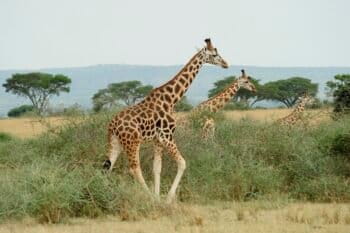
12 critically endangered Nubian Giraffes were recently relocated from their home at Murchison Falls National Park to a reserve over 100km away. One of the reasons? Murchison Falls is now being opened up for oil extraction, as almost half of Uganda's oil reserves are thought to lie there. National parks are home to some of the world’s most important biodiversity, and they are increasingly recognised as vital tools in tackling both biodiversity loss and climate change. But around the world, these protected areas are increasingly being undermined by political and economic priorities. So how protected are they, really? Join Conservation Entangled’s Izzy Sasada to learn more.
Big Oil vs. national parks

In war-torn South Sudan, giraffes retain a surprisingly healthy gene pool

David Brown 29 Sep 2026
Giraffes living in the South Sudan’s war-torn savannas are genetically healthy and connected to nearby giraffe populations by gene flow, despite decades of conflict, recent research suggests. These findings show that “regions of the world that have been affected by conflict can maintain a lot of biodiversity and should therefore not be overlooked by genetic studies and conservation efforts,” Sam van Giessen, study lead author and a conservation genomics researcher from the University of Amsterdam, Netherlands, told Mongabay by email. The IUCN, the global wildlife conservation authority, currently recognizes four species and seven subspecies of giraffes. South Sudan is home to two subspecies of the critically endangered northern giraffe (Giraffa camelopardalis): the Nubian giraffe (G. c. camelopardalis) and the Kordofan giraffe (G. c. antiquorum). Between the conflict years of 1985 and 2025, Nubian giraffes in Ethiopia and South Sudan declined by 95%. By 2025, researchers estimated roughly 235 Nubian giraffe survived across South Sudan in isolated pockets, down from an estimate of 15,000 individuals in 1995. To find out the genetic health of these giraffe populations, researchers from the South Sudan government, the Giraffe Conservation Foundation (GCF), and conservation NGO African Parks analyzed DNA from skin biopsies collected from 30 Nubian giraffes in Boma and Badingilo national parks, run by African Parks. As the giraffe population in the region is small, there was some concern that inbreeding could be a problem for the subspecies’ long-term conservation. However, their analysis showed the South Sudan Nubian giraffe population has relatively high levels of genetic diversity and low levels of inbreeding compared to others, such as Kenya’s Nubian giraffe population. This shows the South Sudan population is a genetic stronghold for the Nubian giraffe subspecies, van Giessen said. Previously, the White Nile River was thought to be a barrier to movement and gene flow between the Nubian giraffes in South Sudan and Ethiopia and giraffe populations on the other side of the river. However, the study found evidence of historical gene flow between the populations. Study co-author Axel Janke, a researcher of evolutionary genomics from Germany’s Goethe University, told Mongabay by email that he’s optimistic about the future of Nubian giraffes in South Sudan from a geneticist’s point of view. He added the population is surprisingly genetically healthy, despite the lack of active protection of the population and the prevailing political instability. Julian Fennessy of GCF, also a study co-author, told Mongabay that the Boma–Badingilo savanna landscape is relatively untouched from human development and conflict, and thus remains stable for Nubian giraffes and other wildlife populations to increase. He added that political stability and associated security continues to be a concern, but that improved conservation efforts by the government are making a difference. Banner image of Nubian (formerly Rothschild’s) giraffe in Uganda. Image by Julie Larsen ©Wildlife Conservation Society.
Nubian (formerly Rothschild's) giraffe in Uganda. Image by Julie Larsen ©Wildlife Conservation Society.

Jaco Muller turned his 15-year-old son’s idea into 197 rhino births

Rhett Ayers Butler 29 Sep 2026

Founder's Briefs: An occasional series where Mongabay founder Rhett Ayers Butler shares analysis, perspectives and story summaries.

In 2022, poachers had taken 14 white rhinos from private farms in Namibia in six weeks, so owners started removing their horns. One cow had a horn 86 centimeters (34 inches) long. Jaco Muller said he was nearly in tears when it was removed. “It is such a magnificent animal,” he said. “But for the animal’s sake, it is for the best.” Dehorning gave poachers less reason to kill a rhino. For Muller, the sight of a dehorned rhino was preferable to finding a dead one. The idea for breeding rhinos came from his son, then 15, as a school project. In 2010, Muller converted the family’s antelope-breeding operation into what became the Rhino Momma Project in Namibia’s Kunene region. Muller believed that breeding more white rhinos (Ceratotherium simum), keeping them secure enough to reproduce, and then replenishing populations across Africa could help save the species. So he built a breeding program with a rhino-custodianship farm and the nonprofit Help Our Rhinos Now, or HoRn. The first calf was born in 2013; by 2025, the project had become one of Namibia’s larger privately run rhino-breeding operations. Kifaru Lodge, which Muller opened in 2018, brought in money from tourists to help cover security and rhino care. Muller also supported legalizing the trade in rhino horn. His argument was that prohibition let criminals collect the profits while farm owners and conservation groups paid for security. He compared harvesting horn to shearing sheep: the animal would survive, the horn would grow back, and a regulated market might finance protection. “Right now, only poachers make money from horns,” he said in 2025. That was, and remains, a controversial argument. Opponents question whether a legal trade would enable laundering of poached rhino horns or increase demand. For Muller, the case came from the economics of a breeding program: horns were valuable, and protecting the animals was expensive. He believed rhinos needed populations outside Namibia as well. In a controversial move in 2024, 42 white rhinos from Kifaru Lodge were exported to Texas. He cited the Arabian oryx, which survived through captive breeding and reintroduction, as an example. Muller often used a gyrocopter to survey the reserve from the air, looking for signs of intrusion and checking on rhinos spread across the property. On Sept. 19, Muller, 53, was killed when the gyrocopter crashed while he was monitoring rhinos and wildfire flare-ups near Outjo. By then, the school-project idea had become a herd of rhinos: the project had recorded 197 births since its first calf arrived in 2013. Banner image: Jaco Muller. Image courtesy of the Rhino Momma Project.
Jaco Muller. Image courtesy of the Rhino Momma Project.

Ebola, twins and women-led conservation: Reporting on gorillas for World Gorilla Day

Mongabay.com 24 Sep 2026
Gorillas are among humans’ closest relatives, with a common ancestor dating back around 8 to 10 million years. Both species of gorilla alive today are on the edge of extinction: The eastern gorilla (Gorilla beringei) is listed as endangered on the IUCN Red List, while the western gorilla (Gorilla gorilla) is critically endangered. In its latest assessment of the eastern gorilla, the IUCN found a mixed picture of gorilla conservation. Some of the gorilla populations remained stable, while others faced declines — of roughly 60% for the subspecies Grauer’s gorilla (Gorilla beringei graueri) — in the last 20 years. "Conservation has made the difference between survival and extinction in some regions,” Jessi Junker, a researcher at Germany's Senckenberg Museum of Natural History Görlitz, said in a press release. World Gorilla Day has been celebrated every Sept. 24 since 2017. For 2026, we bring you the highs and lows of gorilla conservation as published in Mongabay this year.

Ebola outbreak puts gorilla conservationists on high alert

The Democratic Republic of Congo declared a new Ebola outbreak in May 2026. As of Sept. 22, 7,773 confirmed human cases had been registered and 3,759 deaths. While there haven’t been any suspected or confirmed cases of Ebola in eastern gorillas, which are mostly endemic to the DRC, conservationists are on high alert, Mongabay's Kayleigh Long reported in June. A previous Ebola outbreak from 2002-2003, caused widespread infection among western lowland gorillas (Gorilla gorilla gorilla) in the Republic of Congo, killing around 5,000 of the animals.  “[W]e observed that Ebola spreads rapidly within gorilla groups, likely due to the physical contacts gorillas have during nap time, play or grooming sessions.” Damien Caillaud, a behavioral ecologist who witnessed the 2000s outbreak, told Long. When one animal is affected, he said, “Almost all the gorillas from the group disappear within a few weeks.”

Two sets of mountain gorilla twins born in the same year

Twins are rare among mountain gorillas (Gorilla beringei beringei), occurring in less than 1% of births. However, park authorities of DRC’s Virunga National Park recorded births of two sets of gorilla twins in 2026, David Akana, Mongabay’s program manager for the Africa bureau, reported in March. Jacques Katutu, the park's head of gorilla monitoring, called the two twin births within three months "an extraordinary event".

Women patrol the outskirts of key Cross River gorilla sanctuary

Women’s collectives in southeastern Nigeria are carrying out patrols and investigating environmental crimes plaguing communities around the Afi Mountain Wildlife Sanctuary, — home to critically endangered Cross River gorillas (Gorilla gorilla diehli) and endangered Nigeria-Cameroon chimpanzees (Pan troglodytes ellioti). Women from two villages have even halted illegal timber deals, according to Francis Akie, head of the Traditional Rulers Council of Ulom, reported contributor Orji Sunday in July. "Our men have failed to stop the threats," Ofre Mary, founder of the Ulom Women's Conservation Collective, told Sunday. "That's why women decided to take a stand." Banner image: A western lowland gorilla (gorilla gorilla gorilla) in Gabon. Image by Rhett A. Butler/Mongabay.
A Western lowland gorilla in Gabon. Image by Rhett A. Butler/Mongabay.

World Rhino Day: What does it take to save a species?

Mongabay 22 Sep 2026
In honor of World Rhino Day, on Sept. 22, here’s a snapshot of Mongabay’s reporting from the past year on the actions being taken to save rhinos from extinction: Reintroduction in Uganda In 1983, the last wild northern white rhino (Ceratotherium simum cottoni) living in Uganda was killed for its horn. But now rhinos are back in the country, contributor Benjamin Jumbe reported in March. In the last year, at least four southern white rhinos (Ceratotherium simum simum) were brought to northern Uganda’s Kidepo Valley National Park and another four to Ajai Wildlife Reserve. The reintroduced rhinos are a different subspecies, because just two northern white rhinos are alive today; both are females. “The translocation helps us not keep all eggs in one basket and create opportunities to mitigate … risks,” Robert Aruho, a veterinary specialist with the Uganda Wildlife Authority told Mongabay. Mozambique’s ‘silent park’ receives rhinos Zinave National Park in Mozambique, the site of a decades-long civil war, came to be known as a “silent park,” because the war nearly decimated its wildlife. Since 2022, 64 white rhinos (Ceratotherium simum) and black rhinos (Diceros bicornis) have been reintroduced to the park, Mongabay’s Shanna Hanbury reported in June. As grazers, rhinos help maintain the grassland ecosystem, creating habitat for other wildlife and mitigating fire risk. “You can imagine if you don’t have rhinos in the park, [there are] very high grass levels, which is a very large fire hazard,” said Antony Alexander, with the Peace Parks Foundation. At least five healthy black rhino calves have been born in the former war zone of Zinave National Park. Rhinos reintroduced in India are breeding In India, reintroduced rhinos are successfully breeding. Between 2006 and 2021, 42 greater one-horned rhinos (Rhinoceros unicornis) were brought to India’s Manas National Park. Researchers followed their progress and found 40 calves have been born there, raising hope among conservationists for the future of the population, though poaching remains a threat, contributor Sneha Mahale reported in May. “Breeding and calving are among the most important indicators that reintroduced rhinoceroses have adapted well to their new environment,” wildlife biologist Deba Kumar Dutta, told Mongabay India. Growing rhino populations need quality habitat Nepal has also reintroduced populations of greater one-horned rhinos to new areas including in Bardiya National Park. The rhino population in the country grew by 16.6% to 752 individuals from 2015-2021. However, the conservation success story comes with a caveat, contributor Bibek Bhandari reported in June. Using GPS collars, researchers tracked five reintroduced rhinos in Bardiya. They found the animals traveled longer than expected distances, likely in search of water and better-quality grasslands and wallowing sites. “Conservation success should not be measured only by population numbers, but also by the health and resilience of the habitats that support them,” rhino researcher Balram Awasthi told Mongabay. Banner image: A greater one-horned rhino in Chitwan, Nepal. Image by Aditya Pal via Wikimedia Commons (CC BY-SA 4.0).

Subscribe

Stay informed with news and inspiration from nature’s frontline.
Newsletter

These dolphins are shouting

Shanna Hanbury 21 Sep 2026
Pilot whales now need to shout to be heard over the rumble of ship traffic in the Strait of Gibraltar, the narrow strip of water between Morocco and Spain. Researchers looked at near and long-distance communication between long-finned pilot whales (Globicephala melas), which are actually a species of large dolphin. They found the mammals were able to increase the volume of their calls used for short distances, but long-distance calling was more challenging, according to their recently published study. The dolphins may not be able to overpower noise pollution in the Strait of Gibraltar when calling pod mates far away, raising concerns that they could become lost and isolated from the group, the researchers said. Roughly 60,000 ships pass through the Strait of Gibraltar each year. Study: Hegeman, M., Macfarlane, N. B. W., Verborgh, P., Gauffier, P., Esteban, R., de Stephanis, R., Tyack, P. L. and Jensen, F. H. (2026). Vocal compensation to noise in long-finned pilot whales (Globicephala melas). J. Exp. Biol. 229, jeb251217. https://doi.org/10.1242/jeb.251217
Pilot whale - thumbnail

Share Short Read Full Article

Share this short

If you liked this story, share it with other people.

Facebook Linkedin Threads Whatsapp Reddit Email
Load more

News and Inspiration from Nature's Frontline.

A collage featuring Ashoka Mukpo, a Mongabay reporter, and a cocoa bean
Videos
Reconstruction of the extinct Herugavialis cairensis with the Great Sphinx and pyramids depicted in the background. Artwork by Karim Zanaty.
Articles
Podcasts

News formats

  • Videos
  • Podcasts
  • Articles
  • Specials
  • Shorts
  • Features
  • The Latest

About

  • About
  • Contact
  • Donate
  • Impacts
  • Newsletters
  • Submissions
  • Terms of Use

External links

  • Wild Madagascar
  • For Kids
  • Mongabay.org
  • Reforestation App
  • Planetary Health Check
  • Conservation Effectiveness
  • Mongabay Data Studio

Social media

  • LinkedIn
  • Instagram
  • Youtube
  • X
  • Facebook
  • Tiktok
  • Reddit
  • BlueSky
  • Mastodon
  • Android App
  • Apple News
  • RSS / XML

© 2026 Copyright Conservation news. Mongabay is a U.S.-based non-profit conservation and environmental science news platform. Our EIN or tax ID is 45-3714703.